Photo: CEC/Kinga Majewska
A statement titled Churches Confront the ‘Russian World’ Ideology, released at the ecumenical conference on “Resisting Empire, Promoting Peace” and adopted by the Conference of European Churches (CEC) Governing Board in March 2026, outlines concrete steps for peace and reconciliation and offers a strong theological critique of the Russian World ideology and its misuse of Christian teaching.
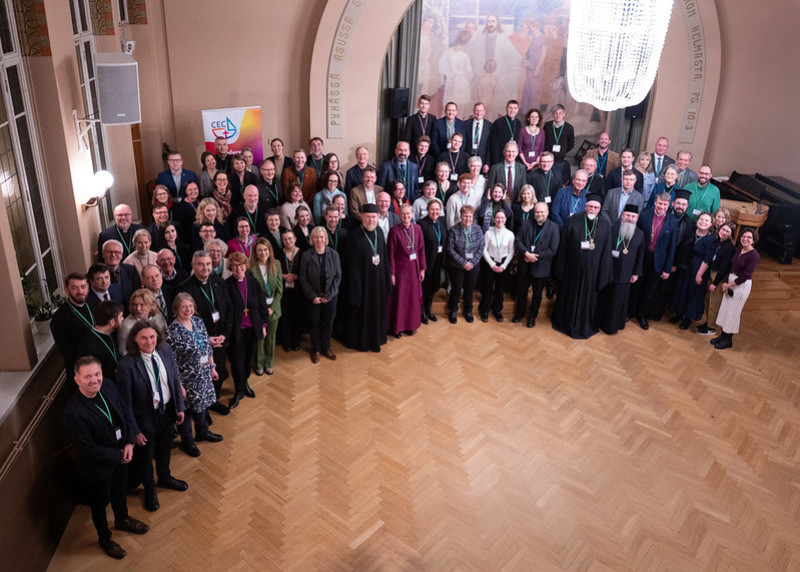
The conference, held from 1–3 December 2025 in Helsinki, Finland, was organised by CEC in collaboration with the Evangelical Lutheran Church of Finland and the Orthodox Church of Finland.
The statement underscores that Russia’s war against Ukraine—fuelled by the ‘Russian World’ ideology—is a military, political, and humanitarian assault that threatens both the lives of millions and the democratic foundations of Europe.
“The ‘Russian World’ ideology denies the national identity of Ukrainians and neighbouring nations, as well as their right to self-determination,” reads the statement. “The Russian Orthodox Church continues to provide quasi-theological and institutional support for the invasion, thereby silencing dissent within its own clergy and other members and promoting so-called ‘traditional values’ to justify Russia’s actions.”
The “Russian World’’ ideology constitutes a distortion of the Gospel at its very foundation, the statement notes. “Every human being bears the image of God—an imprint that cannot be erased, absorbed, or redefined by another,” the text reads. “This is the bedrock of the Christian understanding of the human person: the person stands before God in irreducible dignity, before nation, culture, or civilisation.”
The statement also condemns as heretical any claim that war can be ‘holy’ or that a soldier’s death in battle cleanses sins, rejecting such teachings as incompatible with the Gospel and the example of Christ. It highlights the need for churches to draw on Christ’s threefold ministry—royal, prophetic, and priestly—as a framework for resisting imperial narratives and promoting peace.
The statement further notes that no ideology may subordinate this reality to its own ends. “War is incompatible with the teaching and example of our Lord Jesus Christ,” reads the statement. “The responsibility of the churches is to put Christ into the centre.”
European churches must respond
The statement affirms actions as part of shared witness and ministry within the Pathways to Peace Initiative, framed within the two intertwined paths of ‘Resisting Empire’ and ‘Promoting Peace’.
The actions include offering hospitality to refugees and support to those displaced by the war in Ukraine, safeguarding democracy, and upholding international law.
The statement also calls for strengthening “Ukrainian resistance to the ‘Russian World’ ideology and its devastating consequences,” and challenging “the misuse of faith by the Orthodox and other Churches in Russia.”
The text also suggests cultivating “theological literacy that can recognise and challenge the misuse of religious language, for example, by resisting the temptation to confuse the Reign of God with any given political entity or form of rule,” and encouraging “the collection and preservation of testimonies of survivors and of the fallen.”
Additional actions include supporting truth-and-reconciliation dialogue, strengthening dissident Russian voices, addressing churches’ own imperial legacies, and promoting trauma healing and non-violent conflict transformation.
The statement concludes by urging churches to pray “for those complicit in Russia’s aggression against Ukraine, that God’s grace may lead them to the ways of the Gospel, inspire repentance, and open the path to just peace and reconciliation,” and encouraging churches to safeguard democracy and advocate for the inviolability of international borders, in a spirit of faithfully resisting empire and promoting peace.
Read here full text of the statement