Photos: CEC/Anička Guthrie
Press Release No: 11/26
22 October 2026
Brussels
War, threats to democracy and the need to renew hope shaped the Conference of European Churches’ (CEC) Annual Meeting of the Ecumenical Secretaries. Under the theme “Europe and churches in a changing world”, participants from across Europe explored how churches can respond together to profound political, social and theological change.
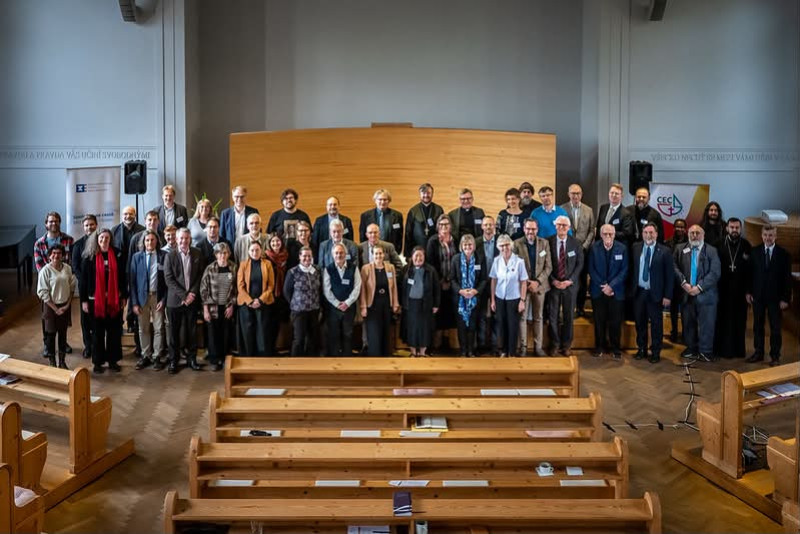
Ecumenical officers from CEC Member Churches gathered in Prague, Czechia, from 20 to 22 October 2026. Hosted by the Evangelical Church of Czech Brethren, the meeting brought church representatives into dialogue with theologians, political voices and ecumenical partners.
Contributions from Ukraine, Cyprus, Denmark and Iceland addressed just peace, humanitarian solidarity, sovereignty and churches’ public role. Fr Roman Fihas, Director of the Institute of Ecumenical Studies at the Ukrainian Catholic University in Lviv, highlighted churches’ humanitarian work and growing practical cooperation.
“Ukrainians long for peace, but a sustainable peace must include justice, security, and respect for Ukraine’s sovereignty,” he said.
Reflecting on the experience of the Church of Cyprus, Metropolitan Bishop Chrysostomos of Kyrenia asked, “how do we contribute to the delivery of fairness, justice and humanitarianism?” His presentation called for peace in Ukraine, the Middle East and Cyprus.
Steinunn A. Björnsdóttir of the Evangelical Lutheran Church of Iceland discussed the use of Christian language to promote nationalist and anti-immigrant attitudes.
“In addressing this challenge, I believe we can learn a great deal from our sister churches in Europe,” she said.
The reception of the revised Charta Oecumenica was a central focus. Participants explored its theological foundations and how its commitments could take root through prayer, education, local cooperation and service. Discussions connected Christian unity with reconciliation, migration, care for creation and young people’s participation.
Sessions on society and theology examined secularisation, climate change, political extremism and declining public trust. Benjamin Roll, a Protestant pastor, connected these challenges with a crisis of hope and encouraged churches to support people working for the common good.
Dialogue with political voices addressed European unity, security and polarisation. Jiří Schneider, Lay Moderator of the Evangelical Church of Czech Brethren, stressed Christians’ responsibility to hold those in authority accountable.
“Speak truth to power. Jesus did so before Pilate, and the prophets before kings,” he said.
Czech parliamentarian Olga Richterová called for stronger European cooperation.
“Europe is a global player. But it needs to be more united to be stronger,” she said. She also recognised churches’ experience of personal encounter and being present for one another.
Young people were integral to the meeting. Representatives of the World Student Christian Federation Europe and the Ecumenical Youth Council in Europe contributed to discussions and prayer life.
“We greatly value the open dialogue and shared reflection at this meeting,” said CEC General Secretary Rev. Frank-Dieter Fischbach. “Listening to the experiences of churches across Europe helps steer and strengthen CEC’s programmatic activities. It keeps our work rooted in their realities and supports our common witness for peace, justice and unity.”
Learn more about the Charta Oecumenica
Learn more about Pathways to Peace
For more information or an interview, please contact:
Naveen Qayyum
Communications Coordinator
Conference of European Churches
Rue Joseph II, 174 B-1000 Brussels
Tel. +32 486 75 82 36
E-mail: naveen@cec-kek.be
Website: www.ceceurope.org
Facebook: www.facebook.com/ceceurope
Twitter: @ceceurope
YouTube: Conference of European Churches