Press Release No: 03/26
20 April 2026
Brussels
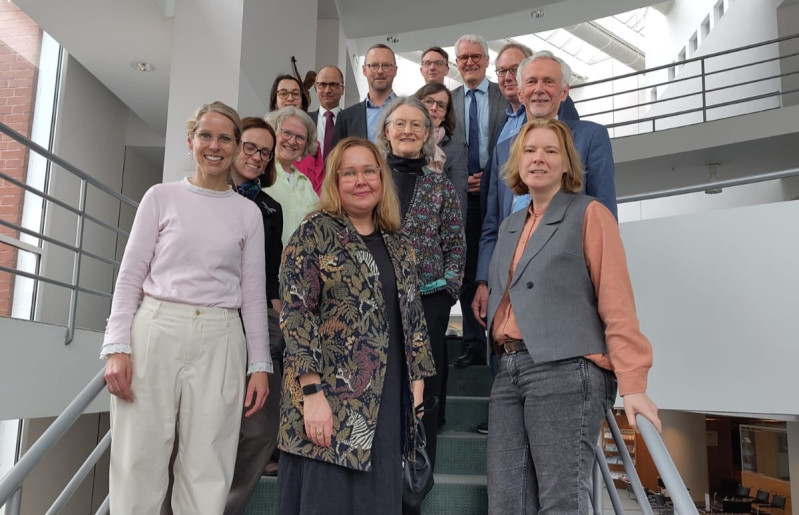
The Conference of European Churches (CEC) brought together its Pathways to Peace steering group in Hannover, Germany, advancing its work on peacebuilding and resistance to war, with a strong focus on Ukraine and Russian anti-war dissent. The meeting was held from 13–15 April 2026, hosted by the Protestant Church in Germany (EKD), in cooperation with the Evangelical-Lutheran Church of Hanover.
The meeting opened with a prayer at the EKD chapel. Church leaders, theologians and peace practitioners from across Europe gathered to deepen reflection and identify concrete steps towards a shared ecumenical understanding of just peace, drawing on experiences from Ukraine, Russia and across the region. They were welcomed by Bishop Frank Kopania of EKD and CEC Vice-President, who highlighted that the steering group meeting offers an opportunity to discuss contributions on peace ethics from different CEC Member Churches.
Bishop Friedrich Kramer, Bishop of the Evangelical Church in Central Germany and Peace Commissioner of the EKD Council, offered a presentation, in which he described the EKD Memorandum on peace ethics as a departure point for further discussion.
Reflections on just peace
Opening the consultation, Dr Maximilian Schell of Ruhr University Bochum highlighted the importance of dialogue across contexts. “Pathways to Peace initiative is creating an important ecumenical space for dialogue on war and peace… indispensable for a forward-looking peace ethic,” he said, noting the central role of Ukrainian churches.
Referring to the EKD 2025 peace memorandum, he stressed that such work offers ethical orientation rather than fixed answers, helping Christians navigate complex moral dilemmas in times of war. He added that the church must serve both as a moral voice and a space for discernment. Peace, he said, cannot be imposed by power alone but must be shaped by justice, reconciliation and responsibility.
Bishop Jochen Cornelius-Bundschuh, Chair of the Action Committee ‘Service for Peace’ (AGDF), said “security is more than military protection,” warning against reducing peace to defence. He called for political solutions, stronger international law and expanded civil conflict management.
Prof. Dr Christine Schliesser of the University of Zurich underlined the role of churches in public life. “As churches, we are called to speak out against injustice and suffering and to speak on behalf of those who cannot speak,” she said. Referring to the CPCE statement on the war in Ukraine, she highlighted a Christ-centred public theology, in which prayer, witness and speaking out against injustice are integral to the churches.
Recent contributions to debates on peace ethics from the Evangelical-Lutheran Church of Finland, the Church of Sweden, and the Church & Peace network—a CEC Organisation in Partnership—were incorporated into the discussions.
Two special sessions were held with the participation of Russian scholars and clergy. They reflected on the role and witness of churches in Europe in the face of conflict, and on the importance of listening to and amplifying voices that challenge systems of oppression, while also offering a living testimony to moral conscience and clarity amid fear and repression.
The meeting also noted that, even amid constrained anti-war dissent in Russia, a number of clergy and lay people risk punishment, defrocking or imprisonment to defy the official narrative. Regardless of risks, they continue to be powerful witnesses to conscience, dignity and truth, whom churches across Europe are called to continue supporting.
The Pathways to Peace steering group comprises Dr Jonas Adelin Jørgensen, Ms Julia Berecz, Rev. Almut Bretschneider-Felzmann, Rev. Antje Heider-Rottwilm, Rev. Sabine Müller-Langsdorf, Rev. Riikka Porkola, Dr Charles Reed, Prof. Dr Christine Schliesser, Dr Andrii Smyrnov, Dr Pavlo Smytsnyuk, and Dr Natallia Vasilevich.
The meeting concluded with a commitment to further develop CEC’s contribution to just peace, including continued dialogue with churches in Ukraine and the wider region. Through Pathways to Peace, CEC reaffirms its role in advancing a just and lasting peace grounded in dialogue.
Learn more about Pathways to Peace
For more information or an interview, please contact:
Naveen Qayyum
Communications Coordinator
Conference of European Churches
Rue Joseph II, 174 B-1000 Brussels
Tel. +32 486 75 82 36
E-mail: naveen@cec-kek.be
Website: www.ceceurope.org
Facebook: www.facebook.com/ceceurope
Twitter: @ceceurope
YouTube: Conference of European Churches