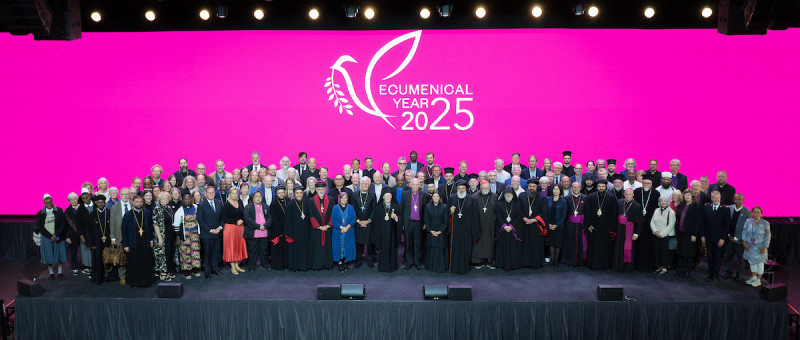
Photo: WCC/Albin Hillert
Press Release No: 08/25
27 August 2025
Brussels
The Conference of European Churches (CEC) made a strong contribution to the Ecumenical Week in Stockholm, held from 18 to 24 August under the theme “Time for God’s Peace.” Through its leadership and initiatives, CEC highlighted the role of European churches in addressing questions of solidarity and peace at a time of war and global insecurity.
CEC President Archbishop Nikitas of Thyateira and Great Britain took part in the panel “In Pluribus Unum: Developing an Ecumenical Hermeneutic to Overcome the Division from 451 and Beyond.” His reflections stressed the importance of dialogue between the Eastern Orthodox and Oriental Orthodox, encouraging churches to deepen unity and overcome historic divisions that still affect Christian witness today.
"It is a blessing and honour to represent CEC in this historical gathering in Stockholm. It allowed another generation to dedicate itself to cooperation and a shared vision. We give a common witness to the world that we can dialogue, face challenges together and grow in our efforts for unity," said Archbishop Nikitas
A full seminar was dedicated to CEC’s Pathways to Peace Initiative, which generated valuable dialogue on how churches can prepare for and shape a just peace in Europe. Ms Katerina Pekridou, Programme Officer for Theology and Studies, contributed.
Pekridou explained how the initiative emerged in response to the Russian invasion of Ukraine, offering space for Ukrainian churches to be heard more clearly.
“Ukrainian churches must have a strong voice in shaping the future of Europe,” she said. She underlined the importance of reconciliation, trust-building, and fresh theological reflection that rejects narratives used to justify war.
Pekridou was a speaker in the seminar “Just Peace in the Context of Ukraine,” held at Andreas Church. The speakers reflected on ongoing global political developments and how churches can respond to the profound theological and political challenges raised by the war, a deep wound in Europe since the Second World War.
She mapped diverse perspectives from European churches in response to the war, particularly regarding the use of force in armed conflict. Reflecting on just peace, she emphasized that it is a holistic concept—a relational journey in which injustice is addressed, equitable relationships are nurtured, and life-affirming policies promote just and sustainable community development through structural transformation.
CEC also played a leading role in the round table “The Church’s Responsibility for God’s Peace.” Rev. Frank-Dieter Fischbach, CEC General Secretary reflected on Europe’s growing concern for security since the war in Ukraine and urged that defence efforts be balanced with diplomacy and peacebuilding. “Europe needs a peace strategy that pairs readiness with reconciliation,” he said. He also reminded churches of their calling to unity, stressing that CEC will continue to provide a platform for dialogue, including through the forthcoming updated Charta Oecumenica. Pekridou spoke about how the churches, gathered in the fellowship of CEC, have understood and expressed their responsibility for God’s peace in the particular context of the Russian war against Ukraine.
Organised by the Christian Council of Sweden with the participation of CEC member churches in Sweden, the week marked the centenary of the historic 1925 Stockholm meeting. The programme featured more than 70 seminars, worship services, and a high-level service attended by the Royal Family and the Prime Minister, alongside youth and public gatherings in Kungsträdgården.
Learn more about the Ecumenical Week in Stockholm (in Swedish)
Learn more about Pathways to Peace
For more information or an interview, please contact:
Naveen Qayyum
Communication Officer
Conference of European Churches
Rue Joseph II, 174 B-1000 Brussels
Tel. +32 486 75 82 36
E-mail: naveen@cec-kek.be
Website: www.ceceurope.org
Facebook: www.facebook.com/ceceurope
Twitter: @ceceurope
YouTube: Conference of European Churches